
Athletic Performance
All athletes are searching for perfection in one way or another. With a training program that’s suited to your body, your sport, and your level of competition, you’ll be able to focus on your sport knowing that your body can safely and effectively move you through with confidence.
We meticulously search for any and all weak links that will decrease performance now, and cause injuries later. Joints work best when they’re balanced, enabling them to channel the massive force of the muscular system into athletic movements, giving athletes more stability, more power, and better agility.
We take an inside out approach to athletic strength. Working from the ground up, we move through five phases that ensure an injury free season, while administering maximum gains in athletic strength.
All this time we’re going to be looking into lifestyle factors that may affect performance, after all, athletes have lives outside of the gym. We’ll take that into account to maximize our time together. Athletes will receive:
- Corrective Exercise Training
- Address muscle imbalance
- Improve stabilization strength
- Coordinate the core musculature
- Teach fundamental movement patterns
- Stabilization/Endurance Training
- Increasing Stability
- Muscular Endurance
- Improving Flexibility
- Increasing Neuromuscular Efficiency of the Core Musculature
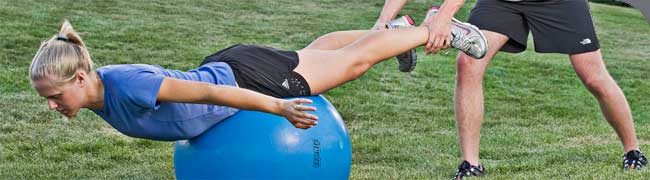
The primary focus when progressing in this phase is on increasing the proprioception (controlled instability) of the exercises, rather than just the load.
Strength and Hypertrophy
Once stabilization is ensured, to reduce injury and provide a stable ground to work on, we can move on to Strength and Power. Specific for the adaptation of maximal muscle growth, focusing on high levels of volume with minimal rest periods to force cellular changes that result in an overall increase in muscle size. This phase of training will be important for athletes such of football players and shot-putters who need extra mass.
- Maximal Strength Training
- Recruitment of More Motor Units
- Rate of Force Production
- Motor Unit Synchronization
Maximal Strength Training has also been shown to help increase the benefits of forms of power training, which is an important adaptation for athletes to maximize.
Power Training
This phase focuses on increasing velocity, rather than load, to achieve the final stage of athletic preparation. This is a very specialized form of training and should be implemented only for those athletes that require maximum speed strength and who have developed optimum levels of stabilization and eccentric strength prior to this phase of training
All the athletes will have a program that is uniquely catered to their bodily characteristics, and their sport. As you'll see in the Process page, there's no guesswork here.